

Why is My Child Failing in School But Testing “Average”? A Parent’s Guide to Learning Disability Evaluations
Specific Learning Disability (SLD)
I hear you. You look at your child’s report card and see concerning grades (Ds, Cs, or failing marks) especially in subjects like reading comprehension or writing. You see the late nights, the tears, and the frustration.
So, you request an evaluation, hopeful for answers. Then, the school psychologist delivers the results: "Your child scored in the average range on the WIAT-4 achievement test, so they do not qualify for a Specific Learning Disability (SLD) evaluation."
It feels like a punch to the gut. How can your child be struggling so badly in school, but the tests say they are just... average?
This is one of the most confusing and frustrating hurdles for families seeking special education services. The simple answer is that the test the school uses is comparing your child to an entirely different group than their classroom.
Let's break down the two standards being used and why they result in such different conclusions.
Listen to my podcast episode above on Evaluations: what to expect, how to request one and why it matters.
Your Child’s World: Classroom Grades and Local Expectations
When your child receives a grade in their 7th-grade math class, who are they being compared to?
The School Curriculum: They are being measured against the specific, demanding standards and pace set by your local school, district, or state.
The Local Peer Group: In high-achieving areas, the average student in that classroom might be well above the national average.
The Conclusion: If your child is struggling to keep up with a rigorous curriculum, or if they are in a highly competitive class, their grades will reflect that struggle. A high school that grades very strictly might give an "F" for work that, nationally, might be considered "C" quality.
In this context, your child is failing to meet the standards set by their school and teachers. This proves they are underachieving locally, which is one part of the SLD picture.
The Test’s World: The National Standard (WIAT-4 Scores)
When the school psychologist or the special education teacher administers the WIAT-4 (Wechsler Individual Achievement Test, 4th edition) for a Specific Learning Disability (SLD) evaluation, the purpose is totally different.
The WIAT-4 is a nationally normed test (the school may use another Achievement Test, but the WIAT-4 is a common one used). This means that your child's score is not compared to their classmates...it is compared to thousands of randomly selected students of the same age across the entire United States.

1. Understanding Your Child’s Score
National Average is 100: On this test, a Standard Score of 100 is the mathematical average for the entire nation.
The Average Range is 85–115: If your child scores in this range, the test is telling the team that their skill (e.g., their ability to decode words) is similar to most children across the country.
The Catch: If your child scores an 88 or 92 on a subtest, the IEP team must conclude: “Nationally, this child is performing in the average range. They are not severely behind the rest of the country.”
2. The Elephant in the Room: The "Severe Discrepancy"
In many school districts, including those in California, the school uses the Severe Discrepancy Model to determine if a learning disability exists.
To qualify for an SLD, the team needs to prove that your child's struggle is not just a local issue, but an inherent, unexpected disability.
They do this by comparing two scores:
Ability (IQ Test): What is your child’s potential for learning? (Let's say their IQ score is 110, or High Average.) Was there a processing deficit?
Achievement (e.g., WIAT-4 Test): What is their actual achievement? (Let's say their Reading WIAT score is 90, or Average.)
The school then looks for a huge gap between these two numbers (often a difference of 22.5 points).
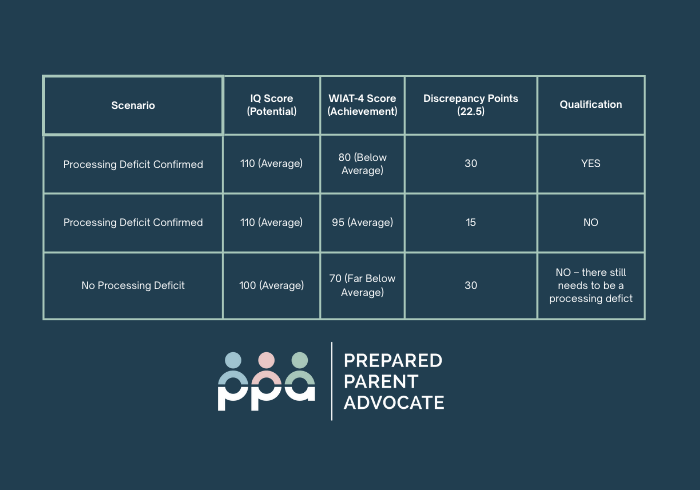
In the second scenario, the team says: "Your child has high potential (110), and their skill is average (95). While they are struggling with the tough schoolwork, their skills are too close to their potential and too close to the national average to qualify as a severe, inherent learning disability requiring special education."
Simply put: Your child might be failing their rigorous local curriculum, but they are not failing the nation.
3. Next Steps You Can Take
Let's say your child does demonstrate a processing deficit (for example, in memory). If your child did not qualify based on the standardized scores alone, you still have options and things you can request the team consider:
Ask About the Pattern of Strengths and Weaknesses (PSW) Model: This newer approach looks at the whole picture, including cognitive processing skills (like memory or processing speed) that might explain the difficulty, even if the achievement score is average.
Ask About the Response to Intervention (RTI) Model: This approach looks at what interventions have already been tried and your child's progress in these interventions. In this model, it may suggest that specialized designed instruction (SDI) under an IEP is the next logical step.
Request Interventions: Ask the school for targeted, research-based interventions (outside of special education) to address the skill gaps documented by the low grades.
Explore other Eligibility Categories. Look beyond the grades and be open to wondering if there might be something more happening: perhaps attention is an area of concern, or anxiety is what is truly impacting your child's education.
Tired of Feeling Confused and Overwhelmed? Let’s Navigate the IEP Process Together.
Understanding these complex test scores and knowing how to advocate for your child’s unique needs is exhausting. You don't have to do it alone.
If you are struggling to:
Interpret your child’s psychoeducational evaluation results (like the WIAT-4 scores).
Challenge the school's determination of "No SLD Qualification."
Develop a strategy to secure services through a different eligibility category (like the PSW Model) or a 504 Plan.
Walk into an IEP meeting with confidence.
As a licensed educational psychologist, I offer 1:1 Parent Advocacy Services to guide you step-by-step.
Fill out the Intake Form so I can learn the specifics of your child's needs.
Book your free 15-minute consultation to see exactly how my 1:1 parent advocacy services can support you.

Monica Trost is the founder of Prepared Parent Advocate. She is an educational consultant, licensed educational psychologist, and mother of children with disabilities. She works with families virtually across California.
Monica Trost, Licensed Educational Psychologist #4660
© 2026 Prepared Parent Advocate